ARU Christmas News Live:: UK festive grocery sales hit record £13.8bn as shoppers favour higher-end own-brand products
India vs South Africa, 2nd Test Highlights: South Africa finished at 247/6 on the opening day as bad light forced an early stumps in Guwahati. Kuldeep Yadav was India’s best bowler as he struck thrice and played a key role in India’s comeback into the game after two good sessions for South Africa. Proteas batters had their starts but no one could make even a half-century as India struck regularly. Jasprit Bumrah, Ravindra Jadeja and Mohammed Siraj also picked up a wicket each for India who are looking to level the series after a loss in Kolkata.
)
Federal Reserve’s influence extends
United States. Its interest-rate decisions shape global capital flows, currency
TEST BLOG POST 1
HELLO BILL GATES
Winter storm disrupts US Christmas travel, impacting airline operations and holiday spending
United States President Donald Trump is at loggerheads with Federal Reserve Chair Jerome Powell, the latter of whom has now been subpoenaed by the Justice Department (DoJ).At the centre of the controversy is Powell’s testimony to the ~Senate~ Banking Committee regarding the Federal Reserve’s $2.5 billion renovation of two office buildings in Washington, DC.The ~grand jury subpoenas issued have been~ linked to that testimony, a move Powell has described as an attempt to pressure the Fed into following the White House’s preferred monetary policy. United States President Donald Trump is at loggerheads with Federal Reserve Chair Jerome Powell, the latter of whom has now been subpoenaed by the Justice Department (DoJ).At the centre of the controversy is Po∑well’s testimony to the Senate Banking Committee regarding the Federal Reserve’s $2.5 billion renovation of two office buildings in Washington, DC.The grand jury subpoenas issued have been linked to that testimony, a move Powell has described as an attempt to pressure the Fed into following the White House’s preferred monetary policy.
https://publish.twitter.com/?url=https://twitter.com/iL0VHWA/status/2013993946968441062
First Blog 1
United States President Donald Trump is at loggerheads with Federal Reserve Chair Jerome Powell, the latter of whom has now been subpoenaed by the Justice Department (DoJ).
At the centre of the controversy is Powell’s testimony to the Senate Banking Committee regarding the Federal Reserve’s $2.5 billion renovation of two office buildings in Washington, DC.
The grand jury subpoenas issued have been linked to that testimony, a move Powell has described as an attempt to pressure the Fed into following the White House’s preferred monetary policy.
Why Fed has been targeted by DoJ
India’s media sector poised for $100 bn growth, says Reliance Chairman Mukesh Ambani The latest escalation became public when Powell disclosed that the Justice Department had issued subpoenas to the Federal Reserve concerning his statements to Congress about the Fed’s headquarters renovation.
“On Friday [January 9, 2026], the Department of Justice served the Federal Reserve with grand jury subpoenas, threatening a criminal indictment related to my testimony before the Senate Banking Committee last June,” Powell said.
The testimony in question addressed cost overruns in a $2.5 billion project to renovate two Federal Reserve office buildings in Washington. Trump has repeatedly criticised the project, describing it as excessive.
Powell highlighted that he respects legal oversight and accountability, stating, “I have deep respect for the rule of law and for accountability in our democracy. No one — certainly not the chair of the Federal Reserve — is above the law.”
However, he also argued that the investigation must be understood within the broader political context of ongoing pressure from the White House over interest rates and control of monetary policy.
“But this unprecedented action should be seen in the broader context of the administration’s threats and ongoing pressure” for lower interest rates and greater influence over the Fed, Powell said.
He went further, asserting that the focus on his congressional testimony and the renovation project was not the real motivation behind the subpoenas.
“This new threat is not about my testimony last June or about the renovation of the Federal Reserve buildings. It is not about Congress’s oversight role…Those are pretexts. The threat of criminal charges is a consequence of the Federal Reserve setting interest rates based on our best assessment of what will serve the public, rather than following the preferences of the President.”
“The Attorney General has instructed her US Attorneys to prioritise investigating any abuse of taxpayer dollars,” a DoJ spokesperson said.
How Trump has been targeting Powell
Trump publicly distanced himself from the Justice Department’s actions, saying he was unaware of the subpoenas issued to the Fed.
“I don’t know anything about it, but he’s certainly not very good at the Fed, and he’s not very good at building buildings,” Trump said in an interview with NBC News.
When asked whether the investigation was intended to pressure Powell on interest rates, Trump replied, “No. I wouldn’t even think of doing it that way.”
Despite this denial, Trump has long criticised Powell’s leadership of the Federal Reserve and has repeatedly called for deeper and faster interest-rate cuts.

A Yars intercontinental ballistic missile is launched during a test from the Plesetsk Cosmodrome in the Northern Arkhangelsk region, Russia. (Representative Image, Credit: Reuters)
Since returning to office an year ago Trump has argued that the Fed’s policies have constrained economic growth and kept borrowing costs higher than necessary.
Trump has also publicly floated the idea of firing Powell, despite legal protections designed to shield the Fed chair from political dismissal.
How Trump has been building a case against Powell
The dispute between Trump and Powell did not emerge suddenly. Trump appointed Powell as Fed chair during his first term, and Powell later received a second appointment under US President Joe Biden. Powell has led the central bank since 2018.
During Trump’s second term, the relationship deteriorated as inflation pressures and economic conditions shaped the Fed’s policy decisions. Trump has consistently pushed for sharper rate reductions, arguing that lower borrowing costs would support economic growth, housing affordability, and business investment.
The Federal Reserve, however, has maintained that interest-rate decisions must be guided by economic data, inflation trends, and employment conditions rather than political demands.
Powell pointed this out in his recent remarks, saying, “The threat of criminal charges is a consequence of the Federal Reserve setting interest rates based on our best assessment of what will serve the public, rather than following the preferences of the President.”
“This is about whether the Fed will be able to continue to set interest rates based on evidence and economic conditions — or whether instead monetary policy will be directed by political pressure or intimidation.”
Earlier in the year, the Fed had taken a more cautious approach in responding to Trump’s criticism, largely avoiding direct confrontation.
In some cases, it even adjusted its policy focus, including scaling back efforts to incorporate climate-change risks into banking supervision — a move that aligned with the administration’s priorities.
Powell’s current term as Federal Reserve chair ends in May. Administration officials have indicated that Trump could announce a successor this month.
Even if Powell is replaced as chair, he can remain on the Fed’s Board of Governors until 2028, preserving his influence over monetary policy.
How US lawmakers & economists have reacted
The Justice Department’s involvement in the dispute has alarmed some members of Congress, including Republican Senator Thom Tillis, who sits on the Senate Banking Committee.
Tillis said the threatened indictment raised serious questions about the Justice Department’s credibility and political neutrality. In response, he announced that he would block any Trump nominees to the Federal Reserve — including a future chair — until the legal matter involving Powell is resolved.
The Senate Banking Committee plays a key role in vetting presidential nominees to the Federal Reserve, giving Tillis and his colleagues significant influence over the central bank’s future leadership.
Peter Conti-Brown, a Federal Reserve historian at the University of Pennsylvania, told Reuters,
“The inquiry into Powell is a low point in Trump’s presidency and a low point in the history of central banking in America.”
“Congress did not design the Fed to reflect the president’s daily fluctuations, and because the Fed has rebuffed President Trump’s efforts to take the Fed down he is launching the full weight of American criminal law against its Chair.”
The Federal Reserve was structured to operate independently from day-to-day political influence so that interest-rate decisions could focus on long-term economic stability, inflation control, and employment conditions rather than electoral considerations.
The current conflict has raised questions about whether those institutional safeguards are being tested more severely than at any point in recent history.
How markets reacted
In the United States, futures contracts pointed to a weaker open, with the S&P 500 down 0.6 per cent, the Dow Jones Industrial Average off 0.5 per cent, and the Nasdaq composite falling 0.9 per cent.
Asian markets, however, moved higher on Monday. Hong Kong’s Hang Seng Index rose 1.2 per cent to 26,547.64, while China’s Shanghai Composite climbed 1 per cent to 4,163.11 after reports that Chinese leaders were preparing additional economic support measures.
South Korea’s Kospi gained 0.8 per cent to 4,624.79, Australia’s S&P/ASX 200 advanced 0.5 per cent to 8,759.40, and Taiwan’s Taiex rose 0.9 per cent. Tokyo’s stock market was closed for a holiday.
Currency movements were modest. The US dollar remained near 158.02 yen against the Japanese currency, while the euro strengthened to $1.1671 from $1.1635.
Commodities saw sharper shifts. Gold prices climbed 1.9 per cent, silver surged 6.4 per cent, and copper gained 1.4 per cent, reflecting increased demand for assets traditionally viewed as hedges during periods of uncertainty.
US crude oil rose to $59.20 per barrel, while Brent crude increased to $63.43.
Despite the political drama, US markets had ended the previous week at record highs. The US Labour Department reported that employers hired fewer workers in December than economists had expected, while the unemployment rate improved.
How Trump is also vying to remove Cook
Parallel to the Powell controversy is Trump’s effort to remove Fed Governor Lisa Cook — a move without precedent in modern US history.
Cook has challenged her dismissal in court, and judges have ruled that she can remain in her position while the case proceeds. The Supreme Court is scheduled to hear arguments on January 21.
The timing is significant. Powell disclosed the subpoenas roughly two weeks before the Supreme Court is set to consider Cook’s case.
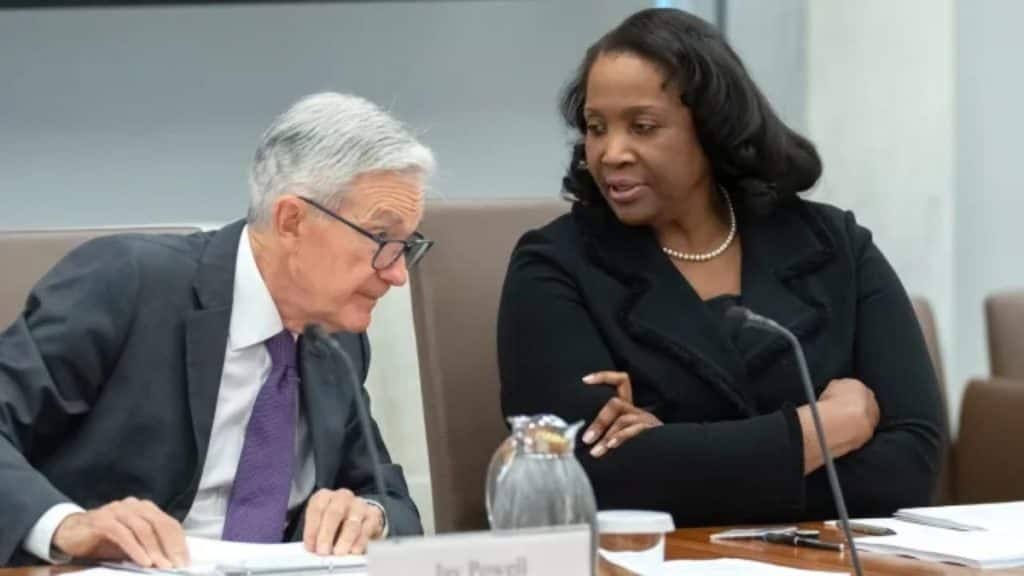
Federal Reserve Board of Governors member Lisa Cook, right, talks with Federal Reserve Chairman Jerome Powell before an open meeting of the Board of Governors at the Federal Reserve, June 25, 2025, in Washington. File Image/AP
Trump’s efforts against both Powell and Cook have reinforced concerns that the Federal Reserve’s leadership is being targeted for resisting political influence over monetary policy.
The Federal Reserve’s influence extends far beyond the United States. Its interest-rate decisions shape global capital flows, currency markets, and borrowing costs worldwide.
Concerns that the Fed’s independence could be compromised may affect investor confidence in US Treasury securities, which are widely viewed as one of the safest assets in the world.
With inputs from agencies

Many Orthodox and Coptic Christians celebrate Christmas on January 7 due to calendar differences
Millions of Orthodox and Coptic Christians are celebrating Christmas on January 7, a date determined by their continued use of the Julian calendar, which is currently 13 days behind the more widely used Gregorian calendar, according to a report in Al Jazeera. The Julian calendar’s slight miscalculation of the solar year causes this drift, meaning the December 25th feast day falls on January 7th in the Gregorian system. While many Orthodox churches, such as those in Greece and Romania, have adopted a revised calendar to celebrate on December 25th, churches in Russia, Serbia, Georgia, and Ethiopia, as well as the Coptic Church, adhere to the January 7th date. This calendar distinction has also taken on geopolitical significance, highlighted by Ukraine’s official move in 2023 to shift its Christmas celebration to December 25th as a way to distance itself from Russian cultural influence.
First Blog 2
United States President Donald Trump is at loggerheads with Federal Reserve Chair Jerome Powell, the latter of whom has now been subpoenaed by the Justice Department (DoJ).
At the centre of the controversy is Powell’s testimony to the Senate Banking Committee regarding the Federal Reserve’s $2.5 billion renovation of two office buildings in Washington, DC.
The grand jury subpoenas issued have been linked to that testimony, a move Powell has described as an attempt to pressure the Fed into following the White House’s preferred monetary policy.
Sign off from News18
- United States President Donald Trump is at loggerheads with Federal Reserve Chair Jerome Powell, the latter of whom has now been subpoenaed by the Justice Department (DoJ).At the centre of the controversy is Powell’s testimony to the Senate Banking Committee regarding the Federal Reserve’s $2.5 billion renovation of two office buildings in Washington, DC.The grand jury subpoenas issued have been linked to that testimony, a move Powell has described as an attempt to pressure the Fed into following the White House’s preferred monetary policy.
Next raises profit forecast to over £1.1bn following strong Christmas sales
High street retailer Next has increased its annual profit forecast by £15 million to exceed £1.1 billion after a robust festive trading period, The Guardian says in a report. The upgrade, its fourth in six months, comes as UK sales grew by 5.9% in the nine weeks leading up to 27 December, significantly outperforming the 4.1% that was expected. Despite the strong performance, the clothing and homewares company has issued a cautious outlook for 2026, anticipating a tougher environment due to what it terms “continuing pressures on UK employment”.
Putin scheduled to attend Orthodox Christmas service
Russian President Vladimir Putin is scheduled to attend an Orthodox Christmas service from January 6-7, 2026, as per a report in Reuters. The media advisory notes that the specific schedule and location for the event in Russia are yet to be determined.
Orthodox Christians mark somber Christmas in Bethlehem amid conflict
Orthodox Christians are marking a somber Christmas Eve in Bethlehem, with celebrations significantly scaled back due to the ongoing Israeli-Palestinian conflict, according to a report in Al Jazeera. The traditional festivities have been overshadowed by a mood of mourning and prayers for peace. The city, revered as the birthplace of Jesus, has seen a near-total absence of foreign pilgrims and tourists, leading to a severe economic impact on its holiday-dependent local economy. These observances follow the Julian calendar, with Christmas Eve on January 6th and Christmas Day on January 7th.
Tradition dictates today is the day to take down Christmas decorations
The Christmas season traditionally spans 12 days from December 25 to January 6, which is widely considered the end of the holiday period, according to a report in USA Today. This Christian tradition dictates that decorations should be taken down by midnight on January 5, known as Twelfth Night, ahead of Epiphany on the 6th. However, contemporary practices vary, with recent survey data indicating mixed public opinion. While many follow the 12-day tradition, 24% of adults surveyed plan to take their tree down later in January, and 20% remove decorations between Christmas and New Year’s Day, showing a divergence from strict religious guidance.
UK festive grocery sales hit record £13.8bn as shoppers favour higher-end own-brand products
UK grocery sales reached a record £13.8bn in the four weeks to 28 December 2025, a 3.8% year-on-year increase, as consumers showed a strong preference for higher-end own-brand products, Marketing Week says in a report. Data from Worldpanel by Numerator indicates that sales of these products grew by 9% to account for 7.5% of total sales, up from 7.1% in the previous year. The average shopper’s expenditure at supermarkets rose to £476 during this period, an increase of £15 compared to December 2024. Among physical retailers, Lidl was the fastest growing, achieving a 10% sales uplift driven by a 5.8% increase in footfall.
{{#blog_title}}
{{blog_title}}
{{/blog_title}}{{{blog_content}}}
United States President Donald Trump is at loggerheads with Federal Reserve Chair Jerome Powell, the latter of whom has now been subpoenaed by the Justice Department (DoJ).
At the centre of the controversy is Powell’s testimony to the Senate Banking Committee regarding the Federal Reserve’s $2.5 billion renovation of two office buildings in Washington, DC.Ñ
The grand jury subpoenas issued have been linked to that testimony, a move Powell has described as an attempt to pressure the Fed into following the White House’s preferred monetary policy.
Why Fed has been targeted by DoJ
The latest escalation became public when Powell disclosed that the Justice Department had issued subpoenas to the Federal Reserve concerning his statements to Congress about the Fed’s headquarters renovation.
“On Friday [January 9, 2026], the Department of Justice served the Federal Reserve with grand jury subpoenas, threatening a criminal indictment related to my testimony before the Senate Banking Committee last June,” Powell said.
The testimony in question addressed cost overruns in a $2.5 billion project to renovate two Federal Reserve office buildings in Washington. Trump has repeatedly criticised the project, describing it as excessive.
Powell highlighted that he respects legal oversight and accountability, stating, “I have deep respect for the rule of law and for accountability in our democracy. No one — certainly not the chair of the Federal Reserve — is above the law.”
However, he also argued that the investigation must be understood within the broader political context of ongoing pressure from the White House over interest rates and control of monetary policy.
“But this unprecedented action should be seen in the broader context of the administration’s threats and ongoing pressure” for lower interest rates and greater influence over the Fed, Powell said.
He went further, asserting that the focus on his congressional testimony and the renovation project was not the real motivation behind the subpoenas.
“This new threat is not about my testimony last June or about the renovation of the Federal Reserve buildings. It is not about Congress’s oversight role…Those are pretexts. The threat of criminal charges is a consequence of the Federal Reserve setting interest rates based on our best assessment of what will serve the public, rather than following the preferences of the President.”
“The Attorney General has instructed her US Attorneys to prioritise investigating any abuse of taxpayer dollars,” a DoJ spokesperson said.
How Trump has been targeting Powell
Trump publicly distanced himself from the Justice Department’s actions, saying he was unaware of the subpoenas issued to the Fed.
“I don’t know anything about it, but he’s certainly not very good at the Fed, and he’s not very good at building buildings,” Trump said in an interview with NBC News.
When asked whether the investigation was intended to pressure Powell on interest rates, Trump replied, “No. I wouldn’t even think of doing it that way.”
Despite this denial, Trump has long criticised Powell’s leadership of the Federal Reserve and has repeatedly called for deeper and faster interest-rate cuts.
Since returning to office an year ago Trump has argued that the Fed’s policies have constrained economic growth and kept borrowing costs higher than necessary.
Trump has also publicly floated the idea of firing Powell, despite legal protections designed to shield the Fed chair from political dismissal.
How Trump has been building a case against Powell
The dispute between Trump and Powell did not emerge suddenly. Trump appointed Powell as Fed chair during his first term, and Powell later received a second appointment under US President Joe Biden. Powell has led the central bank since 2018.
During Trump’s second term, the relationship deteriorated as inflation pressures and economic conditions shaped the Fed’s policy decisions. Trump has consistently pushed for sharper rate reductions, arguing that lower borrowing costs would support economic growth, housing affordability, and business investment.
The Federal Reserve, however, has maintained that interest-rate decisions must be guided by economic data, inflation trends, and employment conditions rather than political demands.
Powell pointed this out in his recent remarks, saying, “The threat of criminal charges is a consequence of the Federal Reserve setting interest rates based on our best assessment of what will serve the public, rather than following the preferences of the President.”
“This is about whether the Fed will be able to continue to set interest rates based on evidence and economic conditions — or whether instead monetary policy will be directed by political pressure or intimidation.”
Earlier in the year, the Fed had taken a more cautious approach in responding to Trump’s criticism, largely avoiding direct confrontation.
In some cases, it even adjusted its policy focus, including scaling back efforts to incorporate climate-change risks into banking supervision — a move that aligned with the administration’s priorities.
Powell’s current term as Federal Reserve chair ends in May. Administration officials have indicated that Trump could announce a successor this month.
Even if Powell is replaced as chair, he can remain on the Fed’s Board of Governors until 2028, preserving his influence over monetary policy.
How US lawmakers & economists have reacted
The Justice Department’s involvement in the dispute has alarmed some members of Congress, including Republican Senator Thom Tillis, who sits on the Senate Banking Committee.
Tillis said the threatened indictment raised serious questions about the Justice Department’s credibility and political neutrality. In response, he announced that he would block any Trump nominees to the Federal Reserve — including a future chair — until the legal matter involving Powell is resolved.
The Senate Banking Committee plays a key role in vetting presidential nominees to the Federal Reserve, giving Tillis and his colleagues significant influence over the central bank’s future leadership.
Peter Conti-Brown, a Federal Reserve historian at the University of Pennsylvania, told Reuters,
“The inquiry into Powell is a low point in Trump’s presidency and a low point in the history of central banking in America.”
“Congress did not design the Fed to reflect the president’s daily fluctuations, and because the Fed has rebuffed President Trump’s efforts to take the Fed down he is launching the full weight of American criminal law against its Chair.”
The Federal Reserve was structured to operate independently from day-to-day political influence so that interest-rate decisions could focus on long-term economic stability, inflation control, and employment conditions rather than electoral considerations.
The current conflict has raised questions about whether those institutional safeguards are being tested more severely than at any point in recent history.
How markets reacted
In the United States, futures contracts pointed to a weaker open, with the S&P 500 down 0.6 per cent, the Dow Jones Industrial Average off 0.5 per cent, and the Nasdaq composite falling 0.9 per cent.
Asian markets, however, moved higher on Monday. Hong Kong’s Hang Seng Index rose 1.2 per cent to 26,547.64, while China’s Shanghai Composite climbed 1 per cent to 4,163.11 after reports that Chinese leaders were preparing additional economic support measures.
South Korea’s Kospi gained 0.8 per cent to 4,624.79, Australia’s S&P/ASX 200 advanced 0.5 per cent to 8,759.40, and Taiwan’s Taiex rose 0.9 per cent. Tokyo’s stock market was closed for a holiday.
Currency movements were modest. The US dollar remained near 158.02 yen against the Japanese currency, while the euro strengthened to $1.1671 from $1.1635.
Commodities saw sharper shifts. Gold prices climbed 1.9 per cent, silver surged 6.4 per cent, and copper gained 1.4 per cent, reflecting increased demand for assets traditionally viewed as hedges during periods of uncertainty.
US crude oil rose to $59.20 per barrel, while Brent crude increased to $63.43.
Despite the political drama, US markets had ended the previous week at record highs. The US Labour Department reported that employers hired fewer workers in December than economists had expected, while the unemployment rate improved.
How Trump is also vying to remove Cook
Parallel to the Powell controversy is Trump’s effort to remove Fed Governor Lisa Cook — a move without precedent in modern US history.
Cook has challenged her dismissal in court, and judges have ruled that she can remain in her position while the case proceeds. The Supreme Court is scheduled to hear arguments on January 21.
The timing is significant. Powell disclosed the subpoenas roughly two weeks before the Supreme Court is set to consider Cook’s case.
Trump’s efforts against both Powell and Cook have reinforced concerns that the Federal Reserve’s leadership is being targeted for resisting political influence over monetary policy.
The Federal Reserve’s influence extends far beyond the United States. Its interest-rate decisions shape global capital flows, currency markets, and borrowing costs worldwide.
Concerns that the Fed’s independence could be compromised may affect investor confidence in US Treasury securities, which are widely viewed as one of the safest assets in the world.
With inputs from agencies
Two years after Hamas triggered the ongoing war in the Gaza "Strip" with its all-out invasion of Israel, Prime Minister's Benjamin, Netan yahu appears to be facing, the toughest moment of his decades-long career. His principal supporter, US President Donald Trump, has told him to make peace with Palestinians — and he would not take no for an "answer".


)
)

)
)
)
)

)

)