

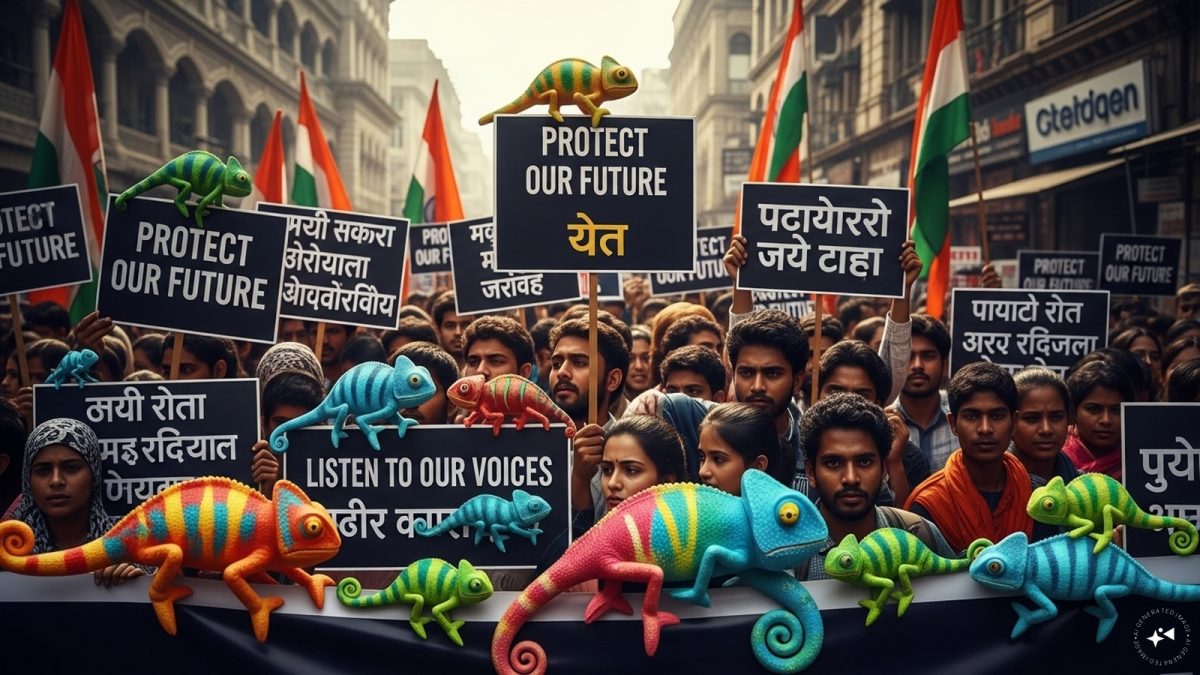
 "Cong MLAs protest MP govt with toy chameleons over OBC quota issue")
Congress MLAs protested at the Madhya Pradesh assembly on Monday, holding toy chameleons to criticize the BJP government for allegedly changing its stance on the 27 percent reservation for Other Backward Classes (OBC). Led by Leader of Opposition Umang Singhar, they demonstrated in front of Mahatma Gandhi’s statue, accusing the government of cheating OBCs. Singhar claimed the BJP-led state government changes its stance like a chameleon and lacks clear policy and intention. He vowed that Congress will continue to fight for OBC reservation, social justice, equality, and constitutional rights. Former minister Sachin Yadav accused the BJP of claiming to support OBCs while depriving them of their rights. Congress has been demanding the implementation of 27 percent reservation for OBCs, which they proposed in 2003.
What Happened
Congress MLAs staged a protest in the Madhya Pradesh assembly on Monday, holding toy chameleons to criticize the BJP government for allegedly changing its stance on the issue of 27 percent reservation for Other Backward Classes (OBC). Led by Leader of Opposition Umang Singhar, the legislators demonstrated in front of Mahatma Gandhi’s statue, accusing the state government of cheating OBCs. Singhar claimed that the BJP-led government is inconsistent on OBC reservation and only seeks to mislead OBCs for votes during elections. The Congress has been demanding the implementation of 27 percent reservation for OBCs, which they claim was proposed by the Congress government in 2003.
Tell Me More
The Other Backward Classes (OBC) in India are a collective term used by the government to classify socially and educationally disadvantaged castes.
The Supreme Court of India has previously ruled on matters related to reservations, including the cap on total reservations at 50 percent.
The issue of OBC reservation is politically significant in Madhya Pradesh, where OBCs constitute a substantial portion of the population.
The Congress party has historically supported reservations for OBCs, with efforts dating back to the 1990s.
Protests and demonstrations are common tactics used by political parties in India to draw attention to specific issues and influence public opinion.
The Voices
“The BJP-led state government is changing its colour like a chameleon on the issue of OBC reservation. Neither the policy nor the intention of the government is clear,” said Umang Singhar, Leader of Opposition.
“When the Supreme Court asks for answers, the government remains silent. But when the elections arrive, the politics of misleading the OBCs and gaining their votes begins,” said Umang Singhar, Leader of Opposition.
“This fight is not just for the reservation, but for social justice, equality and constitutional rights,” said Umang Singhar, Leader of Opposition.
“Inside the house, the government claims to be a well-wisher of the OBCs, but when it comes to giving them benefits, it is working to take away their rights,” said Sachin Yadav, Former Minister and Congress MLA.
Context
In India, reservations or quotas are a system of affirmative action designed to improve the educational and employment opportunities for historically disadvantaged groups. Other Backward Classes (OBC) are one such group, identified based on social and educational backwardness. The percentage of reservation for OBCs has been a contentious issue in various states.
Madhya Pradesh, a central Indian state, has seen political debates over the implementation of a 27 percent reservation for OBCs. The Congress party claims that it had initially set a 14 percent reservation in 1994 and proposed to increase it to 27 percent in 2003. However, they allege that the BJP, which has been in power in the state for several years, has not effectively implemented this increase.
The protest by Congress MLAs using toy chameleons symbolizes their accusation that the BJP government frequently changes its stance on the OBC reservation issue, especially around election times. They argue that the government’s inconsistent policies are misleading and fail to provide the promised benefits to the OBC community, thus undermining social justice and equality.

 "Redirect Category Page URLs from /category/category slug/ to /category slug/ -")
 "\"Race Cars: Engineering Marvels Driving the Future of Competitive Racing\" Testing round 1")
 "\"Race Cars: Engineering Marvels Driving the Future of Competitive Racing\"")
 "Redirect Category Page URLs from /category/category slug/ to /category slug/ -")
 "\"Race Cars: Engineering Marvels Driving the Future of Competitive Racing\" Testing round 1")
 "\"Race Cars: Engineering Marvels Driving the Future of Competitive Racing\"")
 "vantage")


